Manual
[01]

No way to check code directly against the model
You spend hours, days reading the code, to figure out what applies, and check it against the design by hand.

Code review used to be a milestone. Now it lives inside your BIM model: move a wall, run it again. Thirty seconds, thousands of checks, the full codes for your project and jurisdiction, licensed directly from the ICC. Every violation on its element, exact section cited.

Tedious, fragmented code research shouldn't interrupt your workflow. Kestrel handles the detailed code checks so you can stay focused on the building, not the codebook.
Learn morePartners:











Built on official code data through our collaboration with the International Code Council (ICC). Continuously updated.
[ Problem ]
Checking compliance manually means issues stay hidden until they're disruptive, costly, and time-consuming to fix.
Manual
[01]
You spend hours, days reading the code, to figure out what applies, and check it against the design by hand.
Disjointed
[02]

Every time you stop to check code, you lose the thread. So checks happen less often than they should.
Compounding
[03]

Missed requirements don't stay small, growing with every decision built on top.
Costly
[04]

Hours or weeks of rework. Lost fees. Permit delays hitting developers with $12,000 in daily carrying costs.
[ What's Checkable ]

Architects carry the compliance obligation from concept through submission. Reading, interpreting, and applying code requirements at every stage.
That work happens outside the design itself, forcing you to step away from creative flow and revisit compliance in fragments.
Kestrel brings compliance into the design process, showing what passes and what doesn't, as you work, so you're not surprised at submission.
[ How It Works ]
Your model.
Your codes.
Connected.
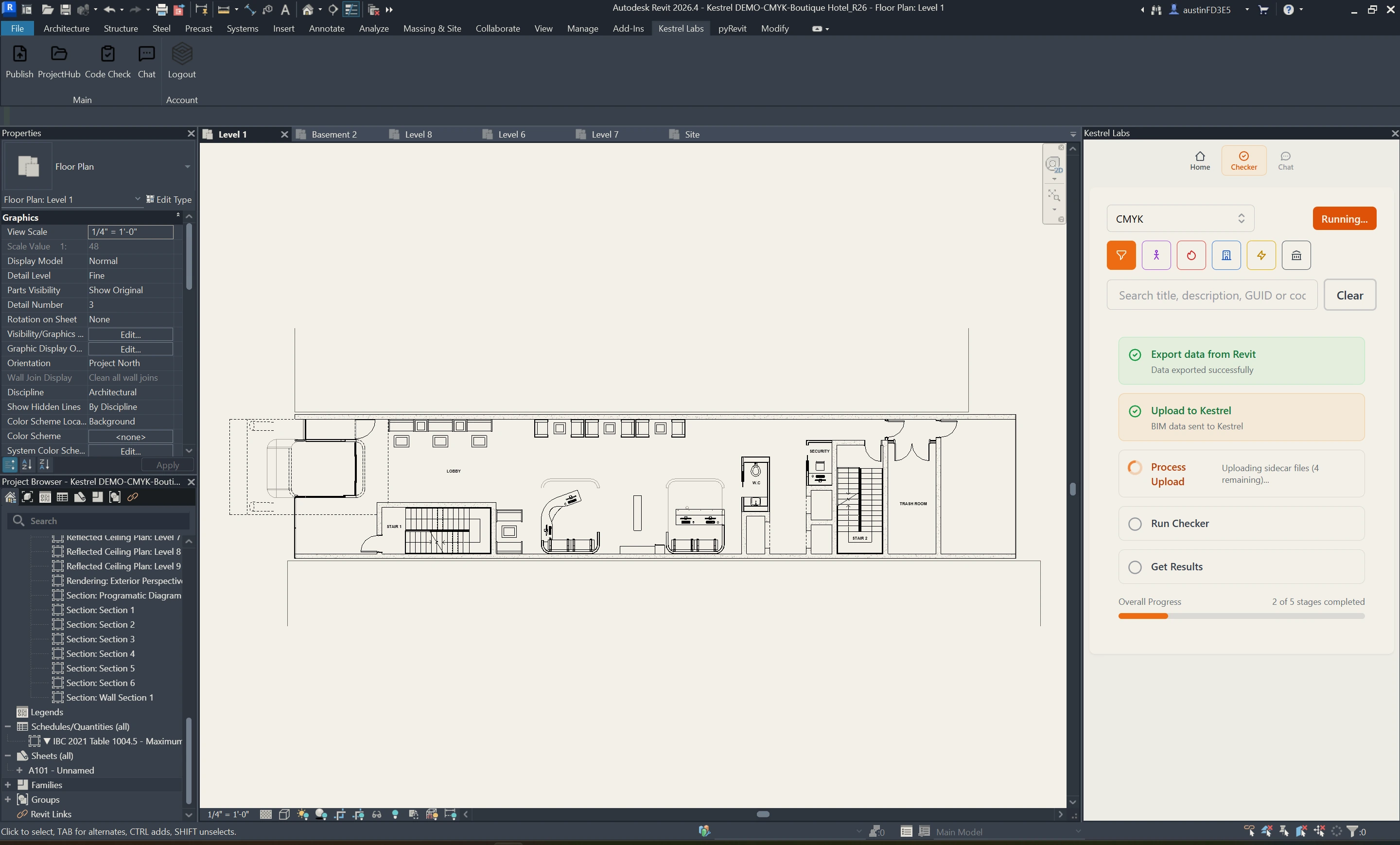
One click in your BIM model. Kestrel applies the codes for your project type and jurisdiction, mapping results to the exact elements in your design. Every check is AI-powered and deterministically verified, with each issue tied to a cited code reference — so you know exactly what to fix and why.
01
Kestrel works inside Revit: no new tools, no workflow changes
02
Checks specific code requirements against your BIM model
03
Shows what's wrong, where it occurs, and why
04
Links every issue back to the code section it comes from
[ Kestrel // Revit live check ]
Basement 02 · IBC 2021 · Frame 01
Kestrel doesn't replace your judgment. It gives you something worth judging.
[ The Kestrel Platform ]
Kestrel Compliance Analysis finds the violation in your model. Kestrel Compliance Chat explains it, citing the section a reviewer would cite. The Kestrel Portal puts both in front of your whole team, no Revit seat required.
Active Reference
IBC 2021 · Table 716.1(2)
Door Fire Rating vs Wall Rating
Kestrel Compliance Analysis
[01]
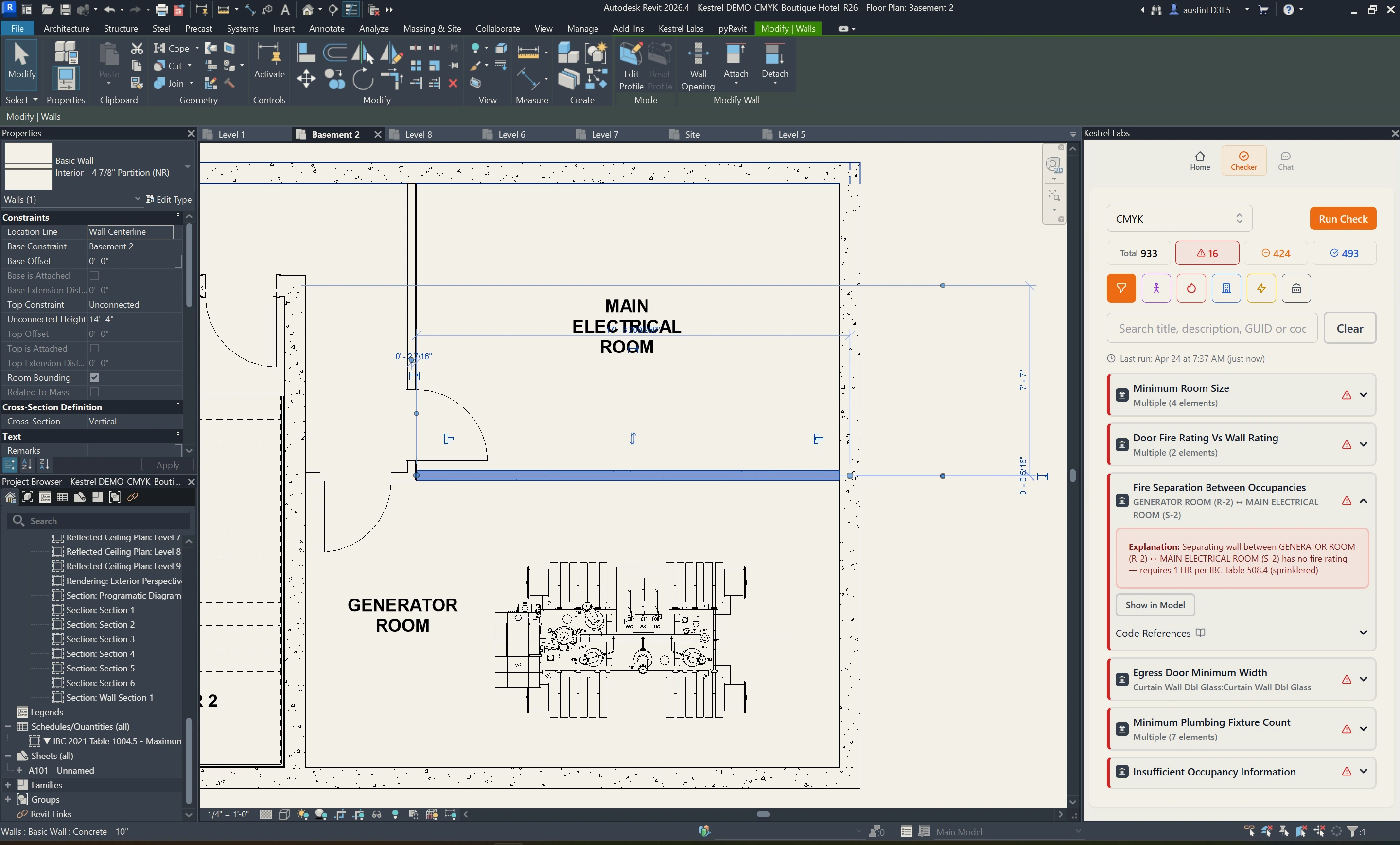
Continuous compliance checks against your BIM model. Every violation tied to a specific element, with the cited code section behind it.
Kestrel Compliance Chat
[02]
Built into the same workflow. Project-specific code answers grounded in your model's occupancy and conditions, cited to source.
[ Design Phases ]
From the first program sketch through the last RFI, Kestrel works with how you already design — applying the right code lens at every stage.
Concept / Pre-Design
[01]
Before a wall is placed, Kestrel helps you understand the code parameters you're designing into — occupancy classifications, height and area limits, and jurisdictional constraints that will shape every decision downstream.
Schematic Design
[02]
Occupancy, egress, and life safety constraints — caught while the design is still easy to change.
Design Development
[03]
Accessibility, clearances, and fire safety — resolved before they're locked into your drawings.
Construction Documents
[04]
Full compliance review before the set goes out. Your first submission is your best submission.
Construction Administration
[05]
When field questions arise, you already know where you stand on code. No surprises. No unexpected Change in Services.
[ Compliance Infrastructure ]
The rules that decide what gets built have always lived in books and PDFs. Kestrel structures them into logic your model can be checked against, jurisdiction by jurisdiction.


[ Use Cases ]
Check compliance continuously in your BIM model, so issues surface during design: not at submission.
Catch accessibility, egress, and clearance issues early, before they turn into redesign.
Permit delays can cost tens of thousands a day. Kestrel catches compliance issues during design, well before they become your problem at submission.
Run comprehensive checks across applicable codes in a fraction of the time of manual review.
Spend reviewer time on judgment calls, not checklist items. Submissions arrive pre-checked against your jurisdiction's requirements.
Bring jurisdiction-specific code checking into the studio, so code literacy is something students practice on their own designs, not just read about.
A code issue caught during design never becomes a claim. Less defect risk reaches the job site, and cleaner projects reach underwriting.
[ Best of Show · Architosh AIA26 ]
“Every few years … a brand-new tool comes out that really has the ability to capture a critical beachhead — that Omaha Beach moment. We believe Kestrel is that.”
Anthony Frausto-Robledo, AIA
Founder & Editor-in-Chief, Architosh
[ Awards & recognition ]
 Best of Show for Innovation Architosh · 12th Best of Show Honors · AIA26 San Diego
  Finalist — Global Innovation Challenge Trimble 0-60 · 2025
  On the Cover of Architectural Products Must-See Products from AIA 2026 · July/August 2026
  No. 1 Fastest-Growing Startup in Colorado Colorado Startups · The Leaderboard · Q3 2026
 [ As seen in ]