
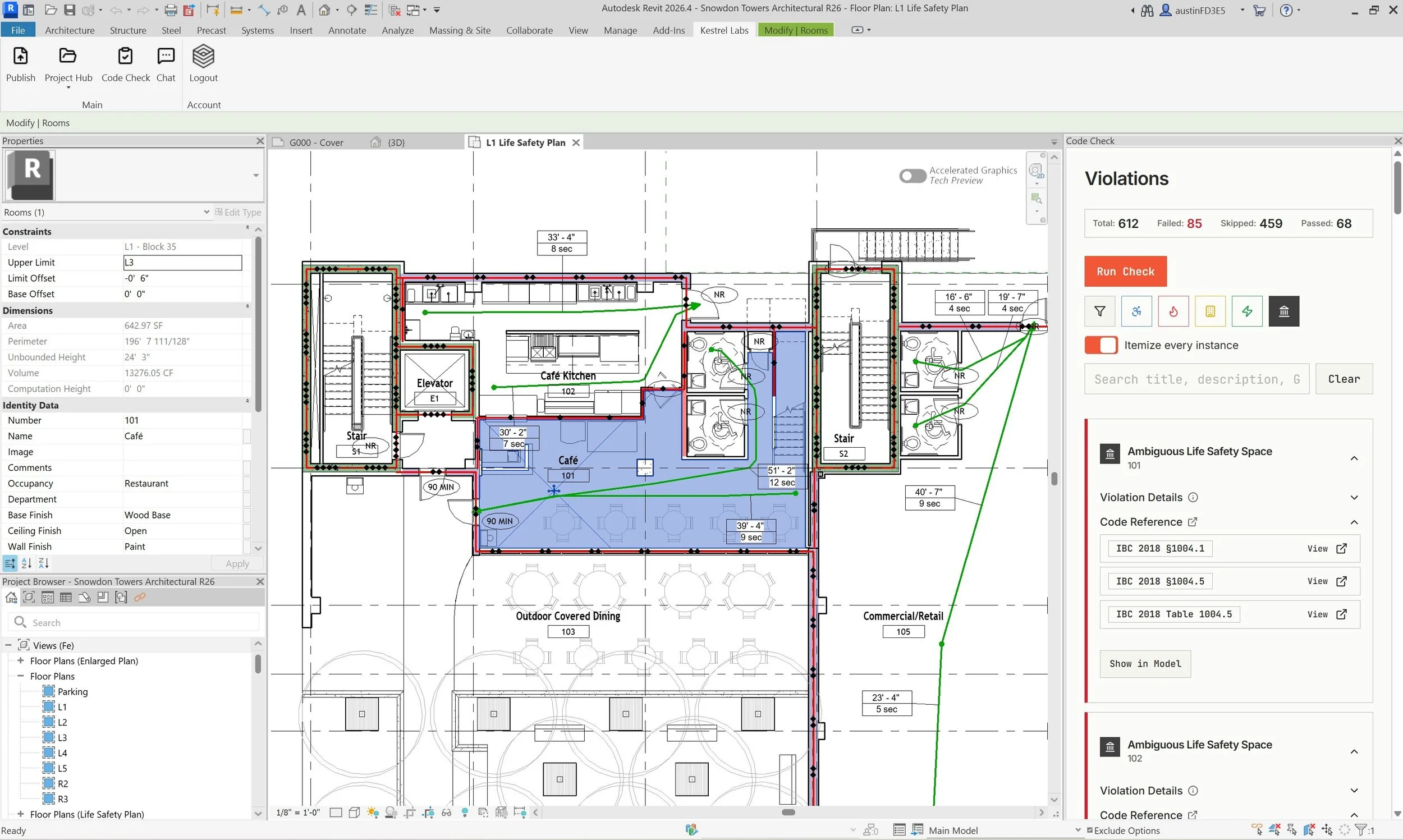
How building code compliance works today
In most projects, code compliance is handled outside the model:
- Architects interpret building code manually
- Teams cross-reference drawings against written requirements
- Code consultants review assumptions late in the process
- Small design changes trigger hours of rechecking
By the time issues are identified, they are often embedded in layouts, coordination, and documentation.
Why building code compliance software hasn't solved this
This isn't just a lack of tools. It's a structural problem. Building code exists as legal text. Design exists as spatial geometry inside a BIM model. Bridging those two requires:
- interpreting written requirements
- mapping them to geometry
- evaluating relationships between elements
That translation has historically been too complex to automate in a meaningful way.
Why plan review tools don't fix the problem
Some tools do exist today for building code compliance. Most of them operate on exported drawing sets, reviewing PDFs to identify coordination issues and inconsistencies across sheets. These tools can catch problems. But they operate after design decisions are already made.
By that point:
- layouts are set
- systems are coordinated
- documentation is underway
A compliance issue at this stage is no longer a small fix. It's rework.
The problem isn't just whether issues are caught. It's when they're caught.
What's changing now
That timing is starting to shift. Instead of checking compliance after design, teams can begin evaluating it directly against the model. This is what's referred to as model-based building code compliance.
From downstream review to in-model evaluation
Traditionally, compliance is something that happens at the end of the process. Now, it's beginning to move earlier — into the design phase itself. Instead of reviewing drawings after the fact, teams can evaluate compliance continuously as the model evolves.
We break down this shift in more detail here: How building code compliance is moving into the model →
Where the market is now
There are tools emerging that attempt to address this problem, but the category is still developing. Most solutions either:
- operate on drawings after export
- or require heavy customization to check specific conditions
We outline the current landscape here: What tools exist for building code compliance in Revit →
What this means
The core issue hasn't been a lack of awareness or effort. It's been the absence of a system that can interpret building code and evaluate it directly against the model during design. That is what is now becoming possible.
For more on how that shift plays out in practice, see catch building code compliance issues during design and why compliance during design beats plan check rework.
If you want to see how this works in practice: Schedule a demo →